
Though most analysts expect the global central banks to keep the liquidity tap open, valuations of Indian markets, they say, are beginning to look stretched. Against this backdrop, they remain cautious, with some even expecting a minor correction from here on.

US rate hike fear keeps Asian firms in check; India most upbeat.

Indian rupee is likely to test 76-76.50 levels as a relatively strong greenback, boiling crude prices and COVID headwinds deepen the depreciation bias for the domestic currency, according to experts. One of the significantly-hit Asian currency in recent months amid uncertain economic times, rupee is expected to see a consolidation in the vicinity of the current level before being pulled towards the depreciation bias. While the equity market has been surging with occasional blips, the rupee has mostly been weak against the US dollar in recent months.

TCS was the top gainer in the Sensex pack, rising around 4 per cent, followed by ONGC, ICICI Bank, HDFC Bank, Dr Reddy's, HDFC and HCL Tech. NSE Nifty advanced 76.65 points to 14,581.45.

Further, the survey found that 60 per cent of the Indians felt under lot of pressure to be successful and make money while 58 per cent were most likely to measure their success by what they own.

'By the 2019 Lok Sabha elections, they moved back to the BJP almost totally and later their backing helped us win the local body elections.'

A look into the state of Dalit entrepreneurship in the country.
Subbarao said, short-term as well as medium-term prospects or Indian economy continue to be grim. Fiscal deficit is going to be much higher, the debt burden much larger and the financial sector will be in a worse shape.

However, the World Bank has projected India's GDP growth rate at 7.5 per cent for the next three financial years, including the current one.
It's time to step on the reforms accelerator.
Over 36 per cent of the 1,630 executives surveyed in India in March this year expected an upturn in the global economy by the end of 2009, as against 34 per cent of North American business executives and 32 per cent of Chinese. Asia-Pacific and Europe recorded 28 per cent and 24 per cent on the hope meter. However, about 62 per cent of Indians surveyed expected the world economy to rebound only by 2010 or later.
The UN Conference on Trade and Development (UNCTAD) said in a report on Monday that a lower but positive economic growth in India in the post-Covid-19 pandemic period and India's large market will continue to attract market-seeking investments to the country. The World Investment Report 2020 by UNCTAD said that India was the 9th largest recipient of FDI in 2019, with 51 billion dollars of inflows during the year, an increase from the 42 billion dollars of FDI received in 2018, when India ranked 12 among the top 20 host economies in the world.
The Reserve Bank remains laser-focused to bring back retail inflation to 4 per cent over a period of time in a non-disruptive manner, Governor Shaktikanta Das stressed while voting for status quo in interest rates, as per minutes of the October policy meeting released on Friday. The central bank has been mandated by the government to ensure the Consumer Price Index (CPI) based inflation is at 4 per cent, with a band of 2 per cent on either side. The retail inflation, which was above 6 per cent during May and June, has started moving down and stood at 4.35 per cent in September.

Supply chain constraints will keep plaguing automobile companies even though demand significantly improved resulting in a 13 per cent year-on-year (YoY) increase in sales in financial year 2021-22 (FY22). Executives at auto firms fear that the Russia-Ukraine war will further dent the sector's prospects of recovery as supply chains face more disruptions. "The visibility in the supply side is so hazy that it is difficult to give even one quarter projection. But all the parameters of demand like pending bookings and enquiries are increasing.

'The most important issue for Indians, the only way in which to get them quickly out of poverty, is sustained high growth.' 'If we are not doing that despite a strong government and a leader with clarity of vision and purpose, we are facing big trouble.'
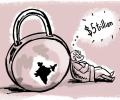
India will need $8 trillion (around Rs 588 lakh crore) of gross capital formation or new greenfield assets to become a $5 trillion (around Rs 368 lakh crore) economy by FY2027, a report said. The report by Deloitte said despite the COVID-19 disruption, FDI inflow into the country provides necessary optimism and display underlying strengths of the Indian economy. In FY2020-21, FDI inflows (including equity, re-invested earnings, and capital) amounted to a record $81.72 billion, 10 per cent higher than the previous financial year, it said.

The prospects for strong, sustained economic reforms do not appear to be promising in India.

While foreign currency rating was retained at Baa2 -- the second-lowest investment grade score -- Moody's also projected a fiscal deficit of 3.7 per cent of gross domestic product in the year through March 2020, a breach of the government's target of 3.3 per cent.

Sharp fall in capital goods production and manufacturing activity also dented sentiments.

Asian Paints was the top laggard in the Sensex pack, falling around 5 per cent, followed by Bajaj Finance, HDFC, IndusInd Bank, Axis Bank and Kotak Bank. On the other hand, Tech Mahindra, Sun Pharma, Bharti Airtel and HCL Tech were among the gainers.

India's services sector activities eased to a three-month low in April, as the rise in business activity was constrained by the pandemic and sentiment towards growth prospects faded, a monthly survey said on Wednesday. The seasonally adjusted India Services Business Activity Index fell to 54 in April from 54.6 in March, the slowest increase in output in three months. In PMI parlance, a print above 50 means expansion while a score below 50 denotes contraction.

A series of steps taken by the government to promote ease of doing business and liberalisation of foreign direct investment norms have helped India receive record FDI inflows so far this year, and implementation of measures like PM Gati Shakti, single window clearance and GIS-mapped land bank are expected to further push investments in 2022. Notwithstanding the global slowdown and the COVID-19 pandemic, total foreign direct investments into India rose to a record $81.72 billion in 2020-21. During April-July this fiscal, FDI (foreign direct investment) into the country increased by 62 per cent to $27.37 billion.

While India's GDP is pegged at 7.7%, China is projected to grow at 7%.

'Rising Covid cases and localised lockdowns are being closely monitored.'

The companies stayed cautious about making fresh commitments and about 46 per cent saw no change in investment levels.

After swinging 439 points during the day, the 30-share Sensex ended 141.33 points, or 0.38 per cent, lower at 37,531.98. It hit an intra-day low of 37,480.53 and a high of 37,919.47.

India's sovereign credit ratings do not reflect the economy's fundamentals, the Economic Survey said on Friday and nudged the global agencies to become more transparent and less subjective in their ratings. The Economic Survey 2020-21, tabled in Parliament, said that sovereign credit ratings methodology must be amended to reflect economies' ability and willingness to pay their debt obligations, and suggested that developing economies must come together to address this bias and subjectivity inherent in sovereign credit ratings methodology. "Never in the history of sovereign credit ratings has the fifth largest economy in the world been rated as the lowest rung of the investment-grade (BBB-/Baa3). While sovereign credit ratings do not reflect the Indian economy's fundamentals, noisy, opaque and biased credit ratings damage FPI flows," the survey said.

Indian businesses have emerged as being the most optimistic about the economy for 2015, with 98 per cent suggesting they are positive about the policies of the new government, way above the global average of 35 per cent, says a report by Grant Thornton.

Reserve Bank of India (RBI) Governor Raghuram Rajan's decision to cut rates last week surprised even top officials.

Dhawal Dalal, executive vice-president & head, fixed income, DSP BlackRock Investment Managers, expects the central bank to hold rates for the rest of calendar year 2016.

The fundamental debate remains where you stand on the long-term growth question. That is what every investor must monitor and come to their own conclusions, suggests Akash Prakash.

By the year 2027, which marks the centennial of the founding of the People's Liberation Army, China will build a fully modern military, a goal that is in alignment with the national strength and will fulfil the future national defence need, state-run Global Times quoted Chinese analysts as saying.

The global ratings agency, however, cautioned that high debt burden remains a constraint on the country's credit profile.

Artificial Intelligence will create 2.3 million machine learning jobs by 2020.
Foreign Direct Investment (FDI) is critically important for India to become a $5 trillion economy, Deloitte CEO Punit Renjen said while noting that over two-fifths of the 1,200 business leaders surveyed in the US, UK, Japan and Singapore are planning additional or first-time investments in India. Referring to the survey, he said India continues to be "one of the most attractive" FDI destinations. "Despite the COVID-19 destruction, inflows hit a record high last year. "Business leaders, whom Deloitte surveyed, are preparing to make additional and first-time investments in India," Renjen said.
The CEOs of Indian companies have emerged as the most optimistic lot in the world when it comes to expectations for improvement in global economy this year and revenue prospects of their own businesses in the longer term.

Professional football has been wiped off the map for weeks, maybe months, after all the major leagues, cups and international competitions were suspended, culminating in the postponement of Euro 2020 and Copa America on Tuesday.

The Indian economy's election-year syndrome cannot be ignored, says A K Bhattacharya.

While the remainder of the IPL has been shifted to the United Arab Emirates between September 15 to October 15, the BCCI doesn't want to let go the opportunity of hosting the T20 World Cup in October-November.

The IMF said global growth is projected to reach 3.9 per cent in 2018 and 2019, in line with the forecast of the April 2018 WEO, but the expansion is becoming less even, and risks to the outlook are mounting.
